

Telematics has stopped being a “nice extra” and become a market standard. Large manufacturers such as Caterpillar, John Deere, Komatsu, and Volvo have monetized connected machines for years—using operational data to improve engineering decisions, optimize service, and build digital revenue streams. Customers increasingly choose equipment not only by hardware specifications, but by the quality of the “digital layer” around it: visibility, diagnostics, recommendations, and uptime.
For small and mid-sized OEMs, matching that experience has traditionally required years of development, multiple specialized teams, and long-term operational commitment. UNUM IIoT closes this technology gap, enabling OEMs to launch their own branded telematics service at an enterprise level—without building a full-scale IT department or reinventing the core platform.
Why an OEM Needs Its Own Telematics
From a manufacturer’s perspective, telematics solves multiple business problems at once:
- Warranty management and cost reduction
Real operating data shows how components were used: overloads, overheating events, low-oil conditions, and maintenance patterns. This helps distinguish factory defects from misuse, reduces unjustified warranty costs, and provides clear documentation for disputed cases. - Engineering intelligence
Systematic data collection before and during failures turns isolated breakdowns into an analytical database. It becomes easier to identify recurring patterns, pinpoint weak points in design or control logic, and decide on component modifications, software updates, and service procedures. - Product improvement based on real-world duty cycles
Load profiles, operating modes, climate conditions, and usage patterns from the field provide evidence for design changes, adjustment of safety margins, and optimization of service intervals. In practice, the OEM gains a distributed “live test lab” across its installed base. - Customer experience and brand perception
A branded portal or app with clear reports, utilization metrics, and service recommendations positions the manufacturer as modern and outcome-focused—not just a supplier of “metal.” It also strengthens the OEM’s direct relationship with end customers. - Digital revenue streams
Telematics packages, advanced analytics subscriptions, and paid remote diagnostics can create sustainable recurring revenue for OEMs and their dealer networks.
The Typical Situation Today: Telematics Exists, but Value Doesn’t
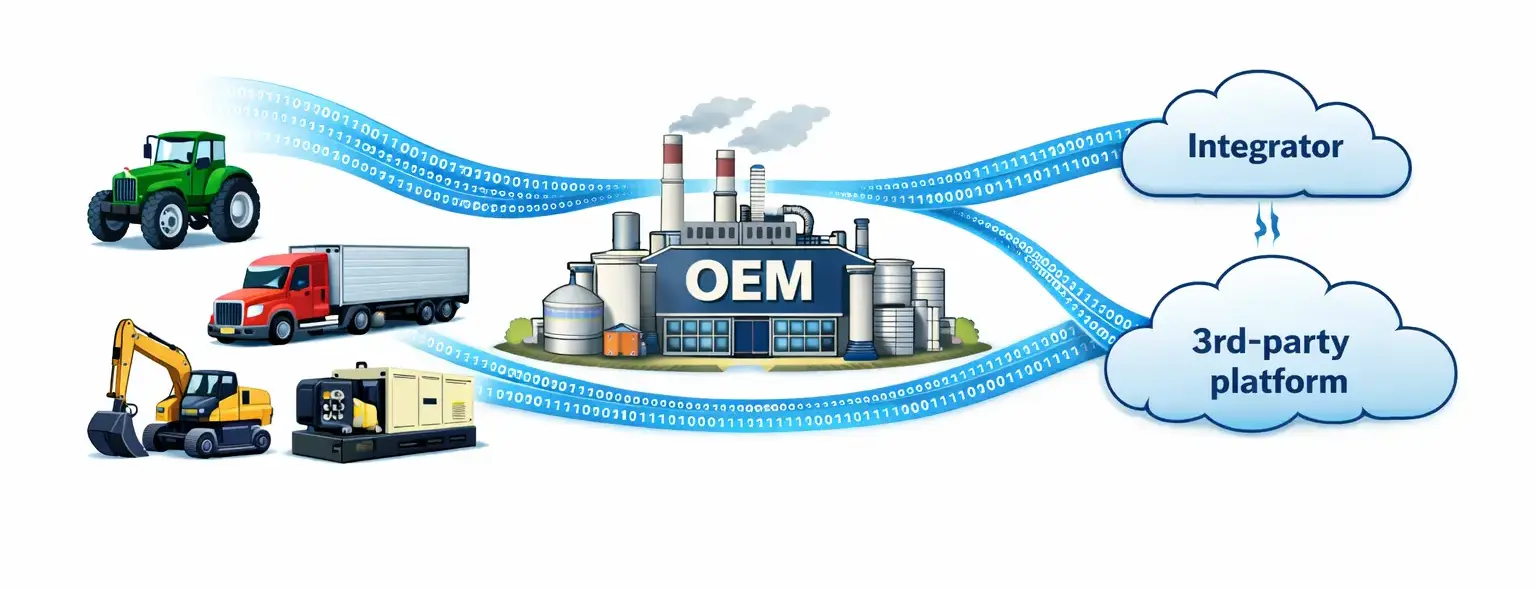
Many smaller OEMs still rely on hardware and platforms selected by dealers or third-party integrators. In this model, the OEM often has limited or no access to the data collected from its own machines.
The drawbacks are strategic:
- Data ownership is lost: operational data flows into third-party clouds, and the OEM loses insight into real-world machine performance.
- No parameter consistency: integrators interpret CAN bus data differently and define parameters in incompatible ways.
- Poor comparability: reporting can’t be reliably compared across fleets, regions, or models.
- Variable quality: the same base machine can “look” very different in telematics depending on dealer priorities and implementation.
The OEM can claim “telematics is available,” but captures little of the engineering, service, branding, or revenue upside.
Why OEMs Don’t Just Build It Themselves
A proprietary telematics platform is not a single project—it’s an ecosystem. It typically requires:
- Embedded development
- Backend infrastructure
- Frontend interfaces and UX
- Mobile applications
- Security
- DevOps and operations
And maintenance is often the bigger challenge. Small and mid-sized manufacturers commonly support:
- many supplier components,
- many custom configurations,
- constantly changing modules, engines, and control systems.
Each design change can trigger firmware updates, new parameters, updated diagnostic logic, and UI adjustments. Without a platform designed for continuous evolution, telematics becomes expensive and difficult to sustain.
What UNUM IIoT Provides
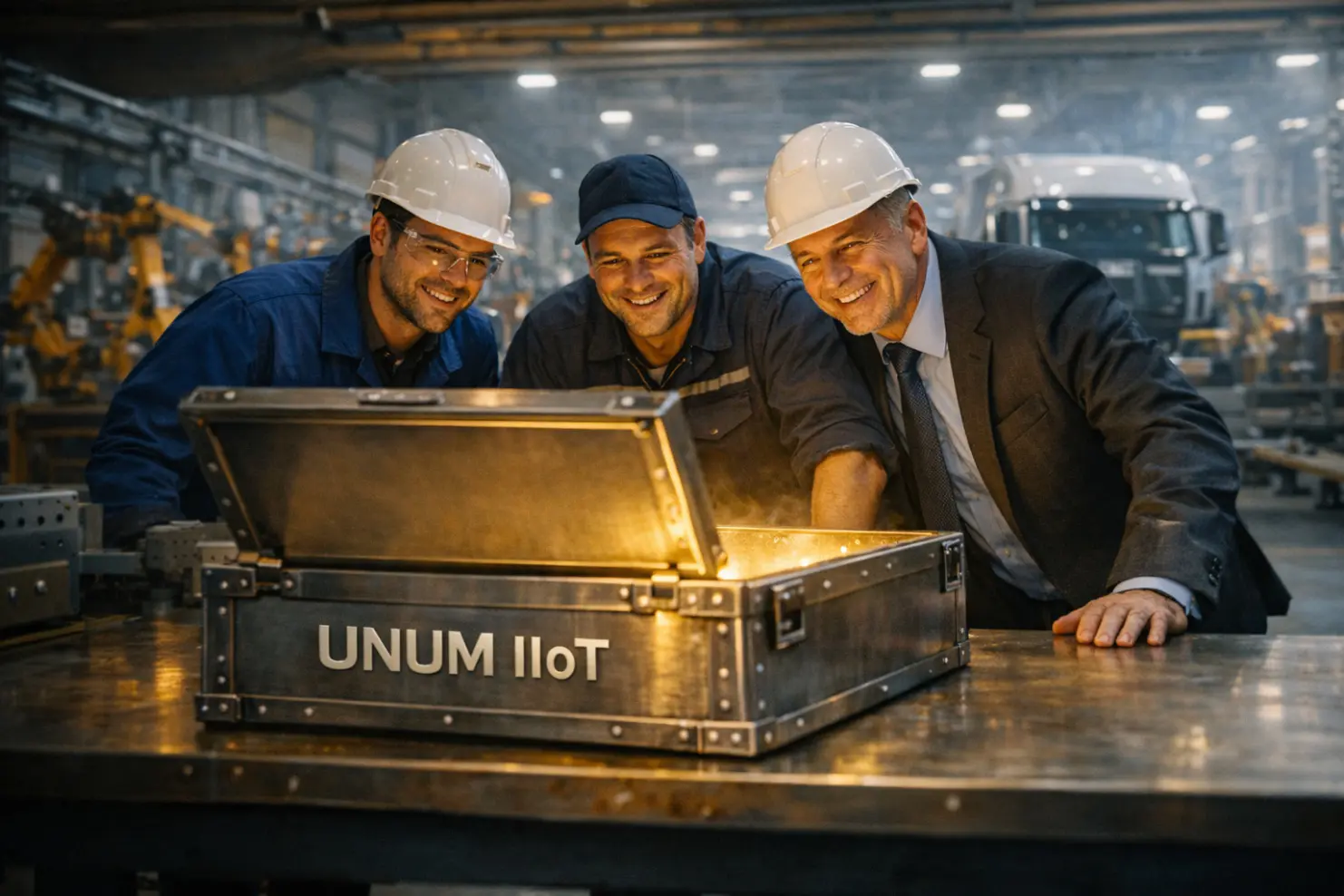
UNUM IIoT is a ready platform that lets OEMs build branded telematics, digital products for customers and dealers, and internal analytics for engineering and service—without massive development investment.
Core Functionality (Expected by the Market)
Out of the box, OEMs get:
- Monitoring of key machine parameters (engine, transmission, hydraulics)
- Diagnostics and fault codes
- GPS tracking, routes, and geofences
- Utilization reports (operating time, idle behavior)
Differentiators (Where OEMs Stand Out)
UNUM IIoT also supports deeper differentiation:
- Deep fuel monitoring and process control
Integration with flow meters and level sensors, detection and analysis of refueling events and potential drains, and monitoring of hundreds of parameters without uncontrolled data traffic through an event-based model. - Role-based access
Tailored views for:- OEM teams (engineering, service, warranty)
- Dealer/service partners
- Fleet owners
- Rental/leasing companies
- Parameter unification
Parameters are defined through a single reference model with unified IDs and scales, making it possible to aggregate and compare reports across different models and product families—and, when needed, across multibrand fleets. - Hardware scalability (concrete limits)
Support for complex machines and systems, including:- up to 8 CAN buses
- up to 8 Modbus devices
- dozens of analog and discrete sensors
This enables multiple controllers per machine and scalable sensor expansion without one-off integrations.
- Industry protocol support
Support for protocols such as J1939, J1708, ISOBUS, and NMEA 2000, enabling faster integration and easier scaling. - Enterprise integration (APIs)
Mature APIs for integration with:- ERP systems
- EAM/CMMS platforms
- Dealer systems
- BI tools
- Two-way communication (remote commands)
Enables remote commands and condition-triggered scenarios such as limits, lockouts, and mode switching—supporting anti-theft, remote calibration, and “machine-as-a-service” concepts. - On-premise deployment
For industries requiring strict data sovereignty (mining, oil & gas, defense, critical infrastructure), UNUM IIoT can be deployed on-premise.
Economics, Operations, and Rollout
Building from scratch typically means multi-year timelines, permanent teams, and the risk of technology obsolescence. UNUM IIoT reduces total cost of ownership because core modules, protocols, dashboards, and configuration tools are already in place.
Operational Footprint
Operating branded telematics on UNUM IIoT can be handled with a small internal team, because the platform includes:
- Software updates
- Standard dashboards and templates
- Configuration and machine model management tools
Implementation Path
Rollout follows clear stages:
- Requirements alignment (models, protocols, roles, KPIs)
- Pilot deployment with data validation
- Standardization in design documentation
- Server deployment (cloud or on-premise) + interface branding
- Marketing enablement and sales materials
- Training for admins, installers, and commercial teams
Proof and Support
- Proven in harsh operating conditions (remote regions, vibration, severe climate): the platform has gone through real-world improvement cycles.
- Technoton support: training for engineers/installers/admins, plus supervision and commissioning support for pilot projects.
The Bottom Line
The market is moving toward every serious OEM offering its own telematics service. The real decision is whether to spend years building the foundation—or to use a field-proven platform designed for OEM reality.
UNUM IIoT helps small and mid-sized manufacturers deliver branded telematics, own their data, strengthen customer relationships, and monetize digital services—without becoming an IT company.