

Telematics gateway
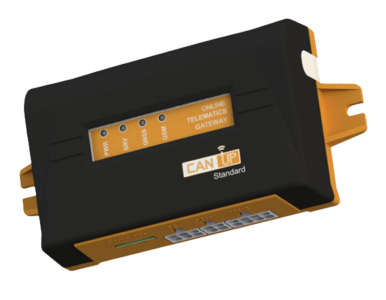


CANUp telematics gateway is designed to collect, process, store, and transmit data on the operating parameters of vehicles, machinery, and stationary assets. It is used as an onboard terminal in vehicle telematics and remote asset monitoring systems to:
- receive and process data from additional sensors and other connected equipment;
- automatically scan and analyze data from standard CAN buses based on SAE j1939/71 or from ISOBUS;
- read Modbus RTU registers of external devices via RS-485 and integrate j1708 data using compatible data converters;
- track asset location using GPS and GLONASS;
- generate, store, and transmit onboard reports via 2G, 3G, 4G (LTE), or Wi-Fi, depending on the CANUp model.
A key feature of CANUp is onboard data processing based on Edge Computing. The gateway calibrates, filters, linearizes, and normalizes parameters, detects events, maintains counters, and generates and stores reports locally, reducing server load and data traffic. CANUp supports 10,000+ standardized machinery operating parameters, transmits onboard reports to a telematics server, and can send event reports directly to users by email or SMS.
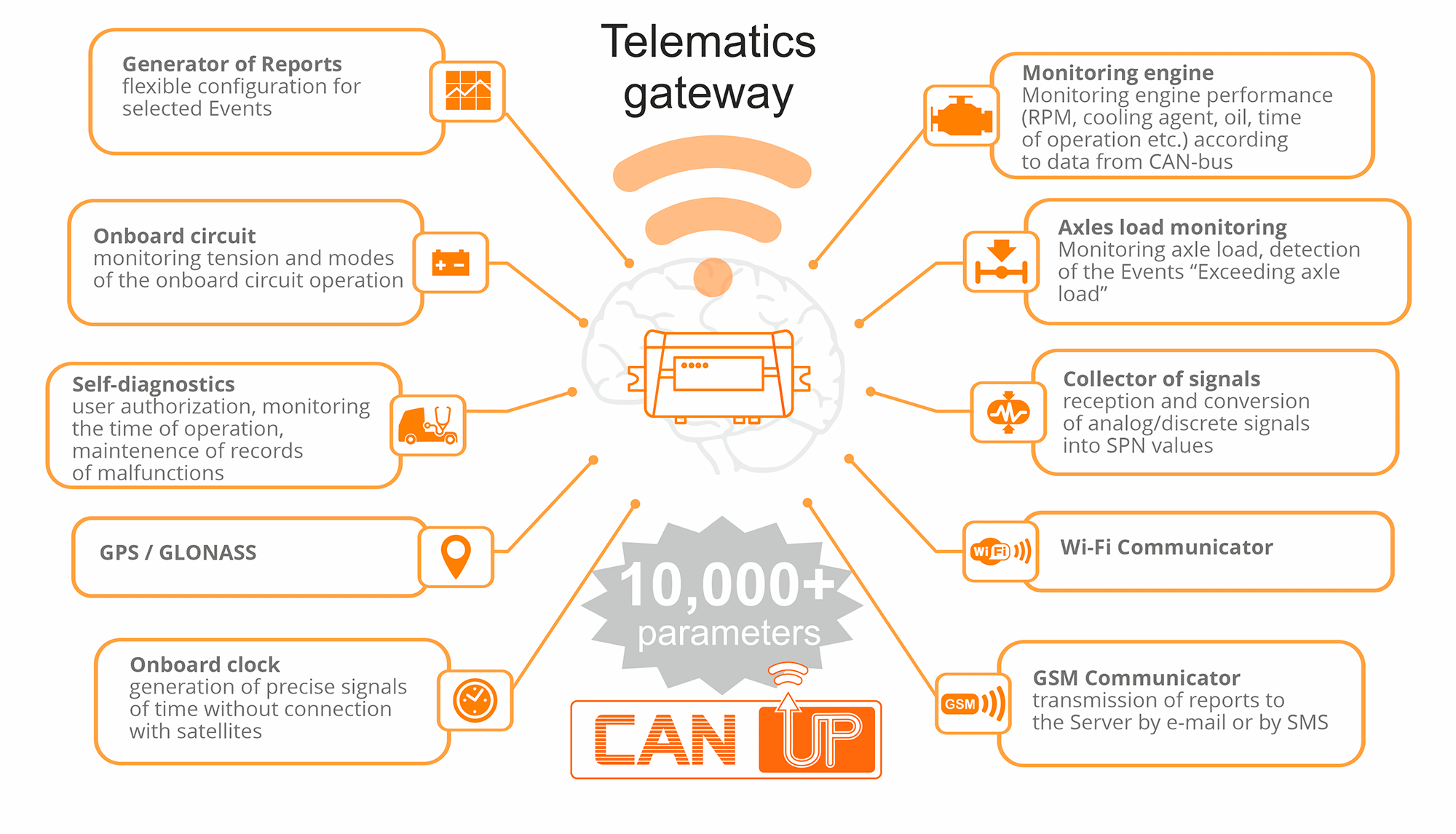
10 000+ telematics parameters
CANUp telematics gateway is designed for monitoring the operating parameters of complex machinery and stationary assets. Advanced machinery telematics solutions based on CANUp can be used for sea and river vessels, railway machinery, mining and quarrying equipment, oil and gas equipment, agricultural machinery, fuel tanker trucks, diesel power generators, boiler equipment, corporate gas stations, and other mobile and stationary assets.
Complex machinery may have one or more engines and fuel tanks, as well as auxiliary, mounted, or trailed equipment such as steam generators, crane booms, manipulators, and blades. It may also incorporate standard analog sensors, digital data buses, and various communication interfaces, all of which need to be integrated into a single telematics system.
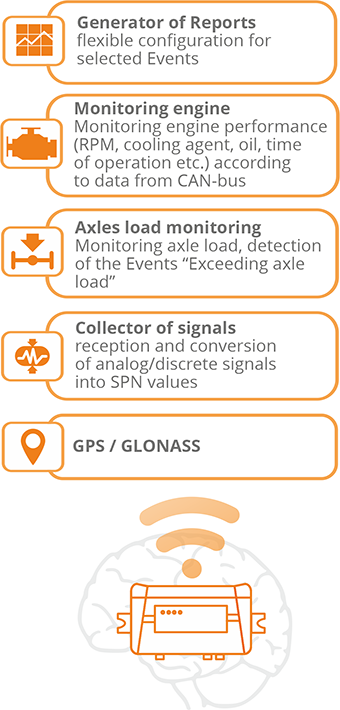
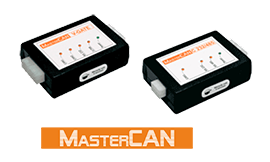
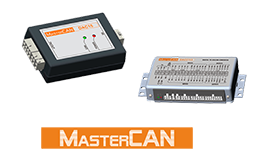
CANUp integrates multiple data sources within a single telematics system. It receives and processes data from additional smart sensors, converts signals from standard analog sensors into digital data, automatically scans and analyzes data from a standard CAN bus based on SAE j1939/71 or from ISOBUS, and reads Modbus RTU registers of external devices directly via RS-485. Data from SAE j1587/j1708 networks can be integrated using a compatible MasterCAN data converter.
CANUp telematics gateway features
Automatic scanning and parsing of 10 000+ operational parameters
CANUp automatically scans and parses 10 000+ standardized machinery operating parameters: 3 000+ parameters from standard vehicle CAN buses based on SAE j1939/71 and 7 000+ parameters of the CAN j1939/S6 telematics interface, ISOBUS, and Modbus RTU. This allows the gateway to be used as a telematics terminal for various types of vehicles, machinery, and stationary assets.
Creating onboard network of smart sensors
CANUp has CAN j1939/S6 (S6 Technology) interface, wireless BLE-connectivity (S7 Technology) and 2 analog inputs. Up to 100 smart telematics sensors can be connected over the wire, and up to 10 wireless BLE sensors at the same time.


Automatic scanning and parsing of SAE j1939/71 data
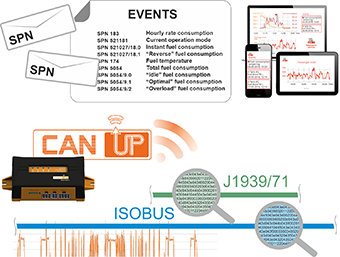
CANUp automatically scans a standard CAN bus based on SAE j1939/71 or an ISOBUS network, receives telematics and diagnostic data, and converts it into standardized SPNs. The user selects which parameters should be included in the onboard reports, without the need to manually parse HEX messages from the CAN bus.
High definition of data
CANUp measures operational parameter change with a step 0.1-10 seconds, thus increasing distinctness of Reports sent to a telematics server. Detailed information on machinery operation enables implementing predictive technical maintenance approach.

Automatic event detection and notifications
CANUp automatically detects events when selected operating parameters change according to preset criteria—for example, a fuel discharge, voltage surge, or pressure drop. Event notifications can be sent directly to users by email or SMS, allowing fleet managers and technicians to respond promptly, prevent potential equipment failures, and reduce maintenance and repair costs.
Event-based model of report generation
CANUp generates, stores and sends Reports on object operation on a timer basis, and upon recognizing an Event. That model ensures important telematics data will be reported in time. Also, CANUp promptly sends the Reports directly to users via email and SMS even before sending to a web-based telematics service allowing quick feedback with the object.
CANUp gateway in GPS tracking and telematics systems
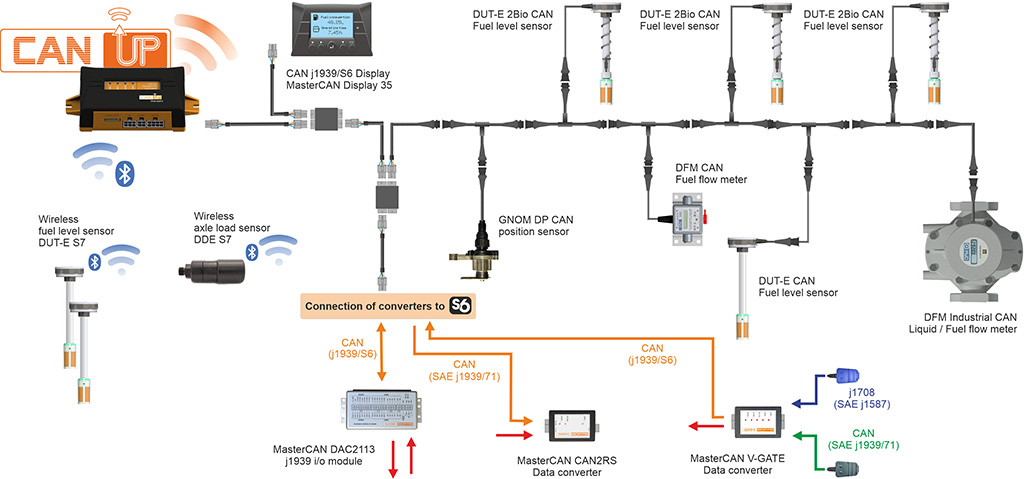
Using the CANUp telematics gateway together with Technoton smart sensors provides the following benefits in integrated GPS tracking and telematics systems for vehicles and stationary assets:
- Guaranteed compatibility with Technoton equipment.
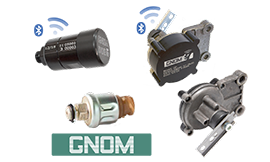
CANUp complies with S6 Technology and is compatible with S6 Units, the S6 Database, and the S6 cabling system. The gateway supports Technoton DUT-E fuel level sensors, DFM fuel flow meters, GNOM axle load sensors, and other compatible equipment. This simplifies component selection, installation, and configuration of the onboard telematics system. - Wired and wireless equipment connectivity.
The S6 cabling system allows 200+ Technoton sensors to be connected to CANUp through a common CAN j1939/S6 bus used for data transmission, power supply, and configuration. At the same time, CANUp can receive data from up to 10 wireless Units via BLE using S7 Technology. This reduces installation time and enables wired and wireless equipment to operate within a single onboard network. - Gateway self-diagnostics and connected equipment monitoring.
CANUp monitors its own performance and the status of each connected Unit in real time. If a malfunction is detected or a Unit disappears from the CAN j1939/S6 network, the gateway generates a corresponding event that can be included in a report and used to send a notification. This simplifies remote diagnostics and helps reduce the number of service visits.
Smart sensors compatible with CANUp telematics gateway
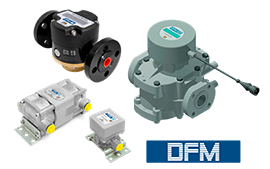
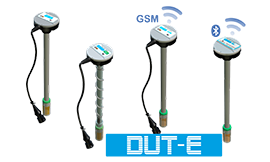
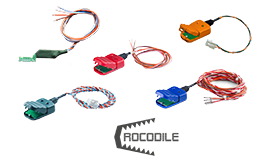
CANUp telematics gateway models
Main technical specifications
| Configurable digital interface | CAN j1939/S6 |
| Non-configurable digital interface | CAN 2.0B (SAE j1939) |
| Serial interface | RS-485 (Modbus RTU) |
| Wireless interface | S7 (BLE) |
| Physical signal inputs | analog, frequency, discrete |
| Buffer memory capacity | up to 40,000 reports |
| Autonomous operation from the built-in battery | 4–6 hours |
| Time to receive GPS/GLONASS signals after power-on | 10 seconds maximum |
| External power supply voltage | 9–45 V |
| Maximum current consumption at 12/24 V | 500/250 mA |
| Operating temperature range | −40 to +60 °C |
| Ingress protection rating | IP40 |
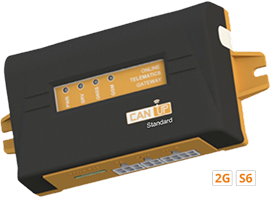
CANUp 27 Standard
- Receiving and processing data from sensors and other devices via the CAN j1939/S6 interface;
- Conversion of analog, frequency, and discrete signals from standard sensors into digital data;
- Generation and transmission of onboard reports to a telematics server, by email, and by SMS;
- Data transmission channel: 2G (GSM 850/900/1800/1900 MHz).
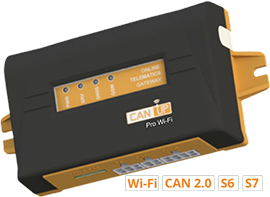
CANUp 27 Pro Wi-Fi
- Simultaneous connection of 200+ Technoton sensors, as well as other devices compatible with the CAN j1939/S6 interface;
- Simultaneous data reception from up to 10 wireless Units via BLE using S7 Technology;
- Automatic scanning and analysis of data from a standard CAN bus based on SAE j1939/71 or from ISOBUS;
- Two separate CAN interfaces: CAN j1939/S6 and CAN 2.0B (SAE j1939);
- Transmission of onboard reports to a telematics server via Wi-Fi (IEEE 802.11 b/g/n).
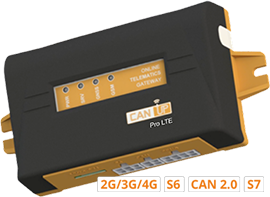
CANUp 27 Pro LTE
- Simultaneous connection of 200+ Technoton sensors, as well as other devices compatible with the CAN j1939/S6 interface;
- Simultaneous data reception from up to 10 wireless Units via BLE using S7 Technology;
- Automatic scanning and analysis of data from a standard CAN bus based on SAE j1939/71 or from ISOBUS;
- Two separate CAN interfaces: CAN j1939/S6 and CAN 2.0B (SAE j1939);
- Transmission of onboard reports to a telematics server via 2G, 3G, or 4G (LTE), depending on the model version.